Sarah Byrne has been a dental nurse for 13 years. She went for a check up at the dentist and the dentist said to her, ‘You seem like an organised girl, would you like to come work here?’
Sarah, ‘I loved it from the beginning. I used to run a petrol station but now I wouldn’t change what I do for anything. I have worked in my practice now for 13 years.’
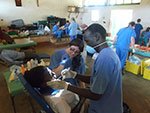
Sarah first heard about Dentaid when a dentist came to work in her practice and told her about a Dentaid project they’d been on. Sarah was inspired and within a few days her trip to Uganda was booked.
‘It all happened really quickly. I never thought I would ever do anything like it. I thought it would be a really scary thing to do but it wasn’t, it was exciting from the moment I knew I was heading out there.’
Sarah was in Uganda for two weeks, working alongside Louise Bambrick (see article.)
‘I’d read the website and felt prepared but the truth is you have no idea what it is going to be like until you get there. I was warned I would feel overwhelmed and sad at times but I couldn’t take the smile off my face the whole time I was there.’
In just 10 days Sarah, Louise and their teams saw nearly 1000 people.
Sarah, ‘We worked with three Ugandan dentists and it was fascinating to see how they worked. In some areas of Uganda there is no electricity or water. These dentists showed us how for example, they prepared cavities for fillings just using hand instruments. It was extremely educational.’
Sarah described a story of an old Ugandan lady who had had tooth ache for a year and was suffering from a lot of pain. Sarah worked alongside an oral surgeon to help with an extraction. When the treatment had finished the woman turned to Sarah and said, ‘You guys are magic, I didn’t feel a thing.’
Sarah expressed that her trip to Uganda had changed her as dental nurse and as a person.
Sarah, ‘I thought I was good nurse before but now I think I’m an even better one.’
Sarah had to raise £2500 for Dentaid to fund her trip. She raised the money personally and by help from patients, family and colleagues. Money needs to be raised for suitcases, materials, needles, gloves, filing materials etc. Sarah also raised money to pay for her flights and accommodation.
In September Louise Bambrick and Sarah Byrne are both planning to do a sponsored skydive to raise funds for their next Ugandan trip next year.
Sarah, ‘It will change you as a dental nurse. You will appreciate what you do. It makes you more passionate about dentistry.’
So, you started out as a dental nurse how did you get into dental nursing?
I started dental nursing when I was sixteen. I had left school and I knew I didn’t want to work in an office. I went to a job recruiters and told them this and they suggested, ‘what about dental nursing?’ I applied to several practices, got a position as a trainee dental nurse and never looked back.
How did you find dental nursing at first?
I loved it. Nursing is an amazing job but I knew it wouldn’t be enough for me forever. After doing my National Certificate at night school, I decided to try and get into hygiene and felt that A-Levels would help me to achieve this. I continued to work full time and also go to night school to do A-Level Biology. Unfortunately, I didn’t get a role as a hygienist as it was very competitive and so I decided to stay in dental nursing. However, I continued to be ambitious. I was promoted to head nurse at my practice so I now had responsibility for training other nurses, I also gained my A-level in Biology and then my Oral Health Certificate.
What did you love about being a dental nurse?
I just found it the job I wanted to do. From the very beginning I was intrigued. I’m such a science geek and I always wanted to learn more. Dentistry is practical and right in front of you, it’s not about looking down a microscope, it’s right there, in the flesh. I loved the diversity as well, every day was different and it never got boring because every patient is different. It is not high paid, glamorous or high powered but I know many dental nurses who would ever change it for an office job. Dental nurses are very passionate about their work. It is a job which hooks you in, you can learn every day, there is always so much more to discover.
What would you say you didn’t like about being a dental nurse?
It was the long hours. When I first was nursing, aged sixteen, I was doing 45 hours a week. However, it is like any job, it has its good days and its bad days.
So, what happened next for you?
I got restless and thought, ‘why not get another A-Level?’ Then, seeing as I had two it just seemed appropriate to go for the hat trick and get three! It was towards the end of completing my final A Level that a friend called me up and asked me ‘why don’t you go to university?’ I was 21, I was worried that I was slightly older than most people applying and I wasn’t sure that they would take me seriously. I was aware that most applicants who apply often have 5 A grade A Levels.
How did the process go?
During the interviews I became aware that although I didn’t have as many A-Levels, I had a lot of practical experience because I had worked for 6 years in dental practice; most people who were applying had never even stepped into one. I was very pleased to get accepted into three different universities and decided to go to the Dental Institute at King’s College London (formerly GKT)
What was university like for you?
It was a 5 year, full time course. First year, I think was the most difficult. It was a lot of pre-clinical information, quite difficult science which you had to slog to get through. However, each year got more and more practical and interesting. My sole aim was to go to university and get my dental degree; I didn’t have much interest in living the ‘student life’. However, I made some amazing friends and they will continue to be friends of mine for the rest of my life.
Did you meet any other dental nurses?
No, I didn’t meet anyone else who had been a dental nurse but I did meet a dental hygienist who went back to do dentistry and some of the students already had a medical degree. I did feel unique, especially when mixing alginate for impressions in a practical; my tutor commented, ‘you’ve done that before.’ Obviously I had, hundreds of times! Things like that did boost my confidence in my studying.
What would you say inspired you to pursue dentistry?
The dentist whom I worked for when I was sixteen. I found I was lucky enough to be nursing for a dentist whose passion and interest in dentistry knows no bounds. He inspired me and showed me just how much was out there. More importantly he recognised my genuine interest and taught me so much, far and beyond the need for nursing. He shared his enthusiasm with me and I was hooked! I’m now back working for him as an associate. Four years after graduating, after VT and a different associate job, I’m back to my old stomping ground! I know it’s not a common thing to do but it is possible and I am living proof.
How would you describe the studying process?
Hard work. It is predominately science: remembering things and understanding how things work. At the same time however, it is very practical. You start by learning how to place fillings in teeth in a phantom head. Learning is based on trial and error. The next stage is practice on patients but you always have teachers guiding you through everything, you aren’t let loose on anyone! We also had regular practical exams, such as O.S.C.Es which consist of 15 stations set up and every 5 minutes you change stations to deal with different scenarios such as a heart attack, CPR , medical history etc. It puts you under pressure. In dentistry you often have to make quick decisions. It’s not life or death but you need to be confident and not back track. I would say that the studying process is fun but it is hard work, it’s five days a week, 8.30am- 5pm. Attendance is a major part of the degree and you are penalised for poor attendance
What experiences did you draw upon from being a dental nurse?
One thing that stands out in my memory is that as a dental nurse I used to look up to the dentists I worked with, I was fascinated by how self-assured and confident they seemed to be. I used to think that I would never be able to be that assertive. This does eventually come naturally to most graduates; five years of uni puts that into you!
Did you have a lot support when making the decision to pursue dentistry?
Yes, I had lots of support from my principal and from my practice, as well as my family and friends. Financially, it is hard and I had to take on loans but it is worth it. At first it was hard to lose my income as a dental nurse. I had been independent from my parents since I was 16 but I looked upon it as an investment in my career, an investment in myself and I’m happy now that I made the decision to go for it.
What do you love about your job now?
It is a great job. I get up in the morning and I don’t dread going into work. I get up and think, ‘I’m going to have a good day today.’ Obviously, sometimes you do have a bad day but I would never say I hate my job.
What advice would you give to other nurses who are thinking about getting into dentistry or develop their careers further?
If you don’t like dental nursing it is not the job for you. It is not a mundane job, it is a career. There is a huge career pathway to follow now which has developed in recent years. When I first started in 1998 this wasn’t the case and there was little aspiration. If you were a dental nurse you stayed a dental nurse. However, dental nurses now need to think about where they want their career to go and think long and hard when they are considering making decisions. Some people choose hygiene because it is shorter than dentistry but don’t let this hold you back. Doing dentistry at university is definitely worth it. There is the option to take a one year access course in science if you don’t have the A-Levels needed for the entry requirements. Don’t be scared; if you want to do it, you can do it and remember it is never too late.
Dental Nurse Inspiration
This week we’re getting behind the scenes of DNN and finding out what it really means and stands for!
Meet Mars!
Mars, what does DNN mean to you?
Dental Nurse Network is an online magazine, with various writers contributing informative, inspirational, relatable and fun information and stories. It is also a place for nurses to connect and talk to one another. I think of DNN as a source for inspiration. We are always gathering stories of other people’s experiences in the dentistry profession and sharing various ideas. We are also focused on post-registration education.
DNN offers access to practical workshops by skilled, professional teachers and also provides that all important verifiable CPD.
If you could describe DNN in three words what would they be?
Dental Nurse Empowerment
How would you describe the role of a dental nurse?
I strongly believe that the position of a dental nurse is unique. You gain specific skill sets; you become an expert in patient care, and you also learn how the surgery and the reception are managed. Many dental nurses don’t often realise they have even acquired these skills. You get a 360-degree view of how everything works in a dental practice and understand the building blocks that are put together. There are some nurses who just suction and pay no attention to anything else. That is fine if you want to stay this way but you won’t develop further if you do. I think DNN inspires nurses to broaden their horizons and use their initiative. Change comes from you and DNN helps you to realise this.
Why do you think dental nurses need empowerment?
I was a dental nurse and I am still a registered dental nurse. I know what it’s like to be a dental nurse. I have been very blessed to work with an extremely great dentist who I now class as a friend. I also have experience temping and worked at other practices. Some of these experiences proved to be rude awakenings. Before launching DNN in April 2010 I felt there was very little for nurses out there and there was not much for them to turn to. The way I want to empower nurses is by motivating them to improve and develop themselves so that they feel more confident to make career decisions and achieve the salary and the working conditions they really want.
When you worked as a dental nurse did you meet many other dental nurses who you felt needed empowerment?
When I was working in my first practice I had no idea what other practices were like. Then when I was temping I saw nurses who were being treated badly, nurses who didn’t really know what was available to them and nurses who didn’t know scope of practice. So, I wanted to create a platform to get this information. I’m not about moaning and complaining, the approach that I take is empowering people to make a change, improve their working conditions or change their working environment.
You also have recruitment experience in dental nursing, what did this reveal to you?
When in recruitment I would ask nurses what implants they had used before and some nurses had been using implants for years and they didn’t know anything about the implant they were using. They didn’t know the implant make, the manufacturer, where it was made or why the dentist was using the specific product. I think it is so important to know these things, not just for yourself but for your dentist and your patients too.
What makes the network unique?
There is no platform which is similar. Dental Nurse Network is the fourth most searched dental nurse term on Google. It gets over 70,000 page hits a month. The average time on the site is 6 minutes. This shows that it is popular and it is what dental nurses want. An average of 25 nurses join our membership every day.
How did your idea for DNN come about?
I was having lunch with a fellow dental nurse one day, Janine Greyling who runs Dental Recruit Network. We were considering what was next for dental nurses. From a small seed of an idea, it grew rapidly.
How does the network support itself?
Most memberships have a fee but I wanted to make DNN accessible to every nurse. The network supports itself by loyal members purchasing affordable online CPD and places on our nationwide courses. Our members support the network by buying from the network. It is the dental nurses themselves who help DNN to grow and grow. I really want to keep courses affordable and available to everyone. Our sponsors Henry Shein and Ivoclar Vivadent help reduce the costs of our courses. They are behind the cause to help dental nurses develop their careers further.
What is the most important element of dental nurse network to you?
Career development. With changes in Direct Access I really feel the industry is progressing, moving forward, changing and we’re moving with it. Developing yourself further as a dental nurse can do a lot for progress into becoming a Specialist Nurse, Head Nurse, Treatment Co-ordinator, Sales, Practice Management, Dentistry and even prospects of owning your own practice.
Do you think your own experiences as a dental nurse has helped you with your business?
Hugely. I understand the industry. I understand what nurses need. What is more, I still gain understanding, I’m always learning more by networking and meeting other nurses myself.
What is the best part of your job?
I love this job. I love business and always have. When working as a dental nurse I always wanted to get into the background of things. At the same time I loved helping people. In this job I get to do both!
What advice would you give to dental nurses out there right now?
I was a very well paid dental nurse and I had extremely good working conditions but at the same time I was confident in my position. I regularly asked for pay rises after proving I was irreplaceable. I want to empower nurses to have the same confidence. This empowerment comes with knowledge. They should seek to know everything they want from their industry and scope of practice.
What is the future for DNN?
Melanie Joyce and I have been developing the Oral Health Education Certificate. This will be in the form of online videos and tutorials, as well as practical workshops held nationwide. Nurses will get the benefits from different types of learning styles. I want to be able to offer many more qualifications, certificates and courses. DNN will continue to network and introduce new courses. I will keep them available, accessible and affordable. I want the network to grow and grow and grow and bring even more dental nurses together.
One last thing, what is the cherry about? What does it stand for?
Before launching DNN we opened up a Facebook page called Dental Nurse and we used it as a blogging page. On the page we used a image of pacha lips with a cherry. The idea behind it was that dental nursing is something which is cool and classy. We didn’t want to put a predictable picture of teeth, we wanted something that would inspire people. We’ve stuck with the cherry ever since. It is a fruit which grows and it symbolises the idea of fruitfulness. Dental nurses can pick cherries just like they can pick their career choices!
Dental Nurse Inspiration
Hi Deanna, so tell me, how did you get into dental nursing?
I always knew I wanted a career in health care. I knew general nursing wasn’t for me, as I knew I couldn’t handle the shifts. I attempted a paramedic course but I couldn’t hack it either. It was then that I considered dental nursing. I liked the idea of steady hours but still in the area I wanted to be in. I applied to my local college and got my qualifications. From then on I was a full time dental nurse. I have worked in NHS, community dental service, hospitals, theatre, private and worked as an orthodontic nurse as well. I’ve seen it all.
How did your career progress from dental nurse to practice manager?
Well, I got promoted to Senior nurse and I was just given more and more responsibility. I think for most people this is how it happens, you are given the practice management role without even realising it.
Did you enjoy the transition?
Yes, I really enjoyed the administrative side of things and I was slowly losing speed as a dental nurse. I didn’t want to be on my feet every day and I wanted to experience something different. I applied for a new job as a practice manager and I was gently introduced to the managing side by my principal dentist. I learnt a hell of a lot. We had to build the practice up from nothing, everything had to be done from scratch. All the polices had to be put in place. As a nurse I did not know any of this existed or was even necessary. From then on I knew that the management position was for me and I’ve stuck with it ever since. I am now back in a small, private, independent practice.
What would you say is the best part of your job?
The best part of the job is managing a really good team and waking up every morning, looking forward to work and not dreading it. I love the fact that I know no two days are going to be the same. I also enjoy the satisfaction that we are providing a service to people and it alters people’s lives. People come in embarrassment and self conscious and we help them feel great about themselves again.
Do you think there are transferable skills from being a dental nurse?
Absolutely, I believe that the best run practices are run by managers who have dental experience. You need to be a manager and own that role but at the same time have empathy with patients and dental nurses. I would never expect someone to do something I wasn’t able to do. When dealing with a complaint I think that my background as a dental nurse helps me to understand the nature of everything and see the big picture. Having dental nurse experience makes me feel extremely confident in the role I am in. Working as a dental nurse is something that will carry with you for the rest of your career.
How would you describe the role of practice manager?
It is interesting, fun and there is never a dull moment! It is also satisfying, you’re responsible for a team of people who hopefully go home at the end of the day happy and have helped lots of people in that day. I always say that working in the dental world is a vocation. It is not a job you can just walk into and pick up that day. It is a lot of hard work and training.
Would you recommend training courses for practice managers?
Yes, I would, even though I personally did not do this myself. It is such a administrative and dynamic role that I constantly update my knowledge and always do my CPD. I still learn things every day. I think that undergoing training courses for someone who is beginning to start out as a practice manager is a great idea. Having qualifications or certificates is what is going to carry you through these days. I got through on experience and because I worked in lots of different areas but for others it might be a good place to start. There are so many options such as open university, internet based courses, courses you can attend. I am not ruling out that I would never do one myself!
Is there any other advice you would give to dental nurses?
It is a unique job and you have to be certain type of person. A bit of a mad one, you might say! However, I’ve made friends for life and it is a great network to be part of. It is close nit community and I love what I do. I’d like to add that our practice has 20 years of experience and it is wonderful to be a part of it!
Dental Nurse Inspiration
Hi Hannah, how did you first get into dental nursing?
When I left full time education I really didn’t know what I wanted to do with my life. As a teenager I had completely unrealistic plans – you know the sort of thing – convert everyone to vegetarianism and achieve world peace!
It didn’t take me long to realise that this wasn’t going to happen and I needed to get myself a job, and in truth it was more by accident than design that I soon found myself employed as a trainee dental nurse.
How do you like dental nursing?
I must confess at first I really didn’t think it was the job for me, but with some encouragement from friends and family, I stuck it out.
The turning point for me was when I was given a Leverson’s textbook and suddenly I found the job began to be more interesting. Looking back now I can see that, actually, it wasn’t the job that I wasn’t enjoying, it was the working environment within my particular practice.
So what did you do next?
I moved practices and slowly began to develop my career. I gained my Dental Nurse Qualification and completed my Oral Health Certificate. It was around this time that I also started thinking about practice management.
I went to work for a corporate practice, starting off as a receptionist. The role developed initially into a Treatment Coordinator position, and then to Assistant Manager, before eventually I was given my own Practice Manager role.
I’ve now worked as a Practice Manager for 14 years.
How would you describe the role as Practice Manager?
I think it’s the classic middle manager role where you’re the one stuck in the middle – acting as the buffer between the dentist principal and your team. It can be a lonely position, and in my experience, more often than not, the Practice Manager is where ‘the buck stops’ - as the phrase goes!
Best part of the job?
I’ve always loved being involved with people and I’m a great organiser, so it’s the combination of working in a large team, meeting our patients and running the practice, with decisions being made on a variety of issues each and every day.
For that reason I firmly believe that every practice should have a manager.
Do you think there are many transferable skills from being a dental nurse?
Definitely - if you’ve worked as a dental nurse you have more of an understanding of policies and procedures, as well as of the patient journey. You also have an in-depth knowledge of what goes on in the surgery and how long specific tasks actually take to be done!
Having been a dental nurse means I really understand the pressure dentists and dental nurses are under – and to be honest I’m not sure dental nurses are as appreciated as much as they should be.
So, for me, those Practice Managers without a dental background will inevitably have a lot of catching up to do to get to the same level of understanding as those who’ve come through the ranks within dentistry.
I’m not saying it can’t be done by those with a background from outside dentistry but it definitely makes it more of a challenge.
What is your role now?
I still work in practice management two days a week, and with the rest of my week spent working for ADAM.
What is ADAM?
ADAM is the Association of Dental Administrators and Managers, and was formed 30 years ago specifically to represent Practice Managers. Originally known as BDPMA, in 2011 we changed our name to reflect our aim to represent all members of the dental admin team, not just the Practice Manager, and by doing so recognise that each and every role is vital to the smooth operation of a busy dental practice. On 6th and 7th June we’ll be celebrating our 20th anniversary at our Annual Conference at the Oxford Hotel, Oxford.
I’d been a member for ADAM (then BDPMA) for a little while when I saw a request for applicants for the role of assistant regional mentors. These mentors help to organise seminars across the country and to promote the association. My employers encouraged me to apply for the role and I was successful.
Again my positions within the organisation gradually developed. I first of all moved up to become a mentor; then regional manager for the South East; then team manager; and more recently Vice President.
This year I will take up the role of President at our AGM at the June Conference.
What exactly does ADAM do?
Our primary role is to provide support and represent the interests of our members, which we do in lots of different ways such as:- • Providing information on changes to legislation and regulation affecting the dental world and explaining how these changes affect dental professionals. • A Question & Answer page on our website – www.adam-aspire.co.uk – linked to a forum where members can talk freely to one another. • Connecting with other organisations to look for new partnerships to benefit all our members. • Providing our two publications to members; Practice Focus which comes out quarterly; and an online magazine E Update which is issued every month. These help spread the news of what’s happening within dentistry and also shares stories about what some of our members have been up to recently. • A legal helpline exclusively available to ADAM members. • The ADAM awards, sponsored by Denplan, where we celebrate excellence by presenting prizes to the Practice Manager, Treatment Coordinator, and Administrator of the Year. • General Advice – members can email or telephone with an enquiry and we will provide the answer or point them in the right direction for assistance. We also have a library of advice sheets available for members to download. • Management Development events with reduced rates to attend seminars, webinars and training course focused on providing Practice Managers and administrators with the commercial skills necessary to run effective, profitable practices.
What advice would you give to dental nurses wanting to become Practice Managers?
I believe it always helps to have undergone some kind of formal management training, whether it’s a diploma or a BTEC in practice management. Apart from anything else this will give you an insight into what you’re getting yourself into!
As a Practice Manager you’ll find that you sometimes need to get involved in difficult situations such as taking disciplinary action against a member of your own team and, in extreme circumstances, this could ultimately lead to their dismissal. Your management training helps gives you the confidence to put your new skills into practice.
I’d also recommend dental nurses to seek out a mentor – someone they get on well with, and trust, and who can advise and guide them in the future.
As I said earlier, practice management can be a lonely job - remember, as a manager you can’t moan to your dentist or your team, so having a good network of other managers and dental professionals around you to bounce ideas off or to let off steam, can be invaluable, and help give you confidence in what you’re doing.
And of course ADAM can help with all this, which is why I always suggest people join!

 Dentaid Uganda
 So, you started out as a dental nurse how did you get into dental nursing?
 This week we’re getting behind the scenes of DNN and finding out what it really means and stands for!
 Hi Deanna, so tell me, how did you get into dental nursing?
 Hi Hannah, how did you first get into dental nursing?